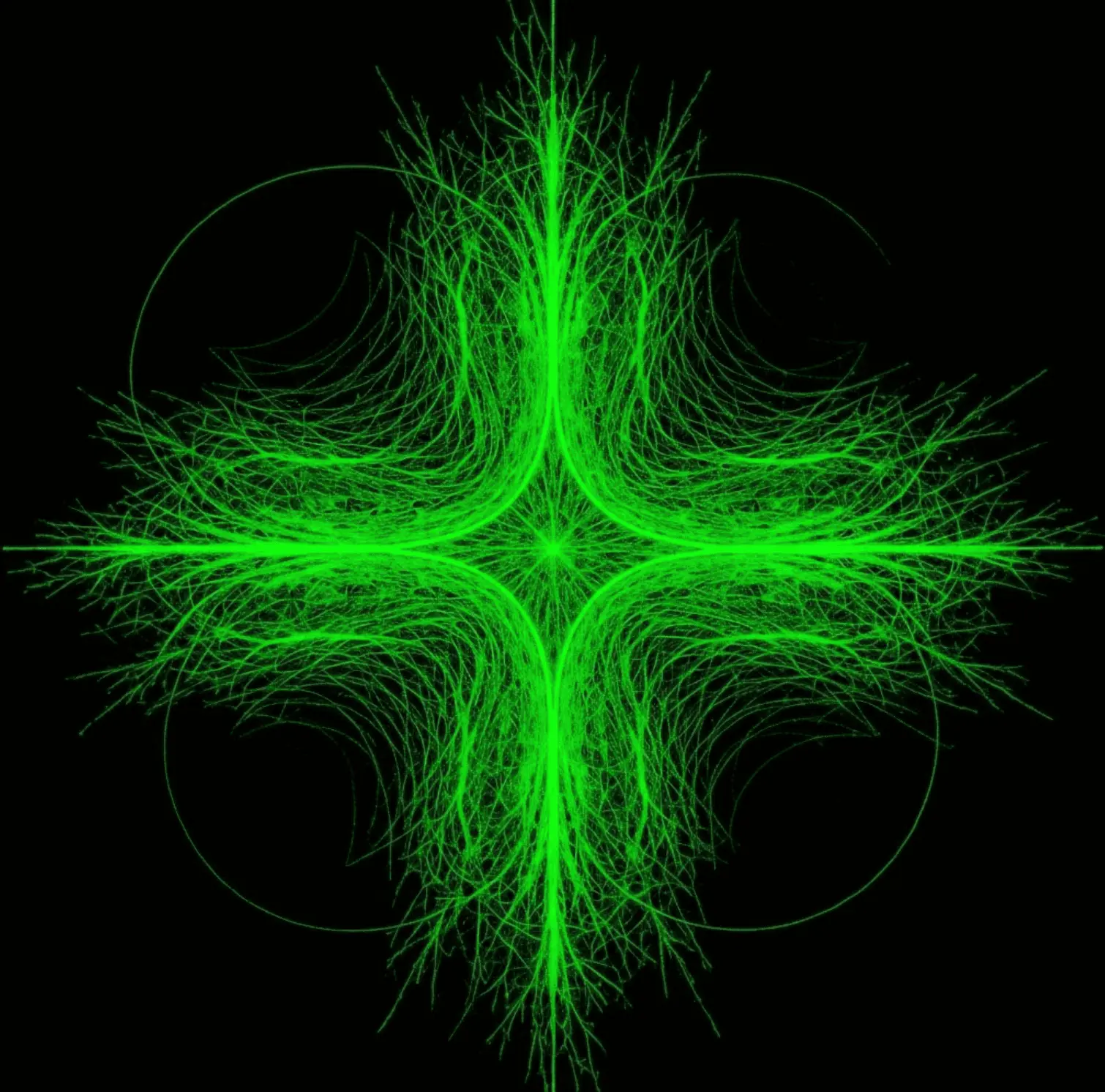
Exploring population growth models through iterative processes, bifurcation diagrams, and chaos theory using Python and mathematical modeling.
This investigation applies iterative mathematics to understand and predict population trends using the logistic map equation. The study demonstrates how growth factors affect population stability, from steady states to periodic oscillations and eventually chaos. Using Python with NumPy and Matplotlib, convergence graphs and bifurcation diagrams were generated to visualize the complex dynamics inherent in population growth models.
Introduction
Iterative mathematics provides a powerful framework for modeling complex natural phenomena, particularly population dynamics. This research investigates how simple iterative equations, specifically the logistic map, can produce remarkably complex behaviors ranging from stable equilibrium to chaotic oscillations. By examining different growth rate parameters, we uncover the fundamental mathematical principles that govern population stability and the transition to chaos.
Key Takeaways
- The logistic map equation reveals how simple mathematical models can exhibit complex chaotic behavior
- Bifurcation diagrams visually demonstrate the transition from stability to chaos as growth parameters change
- Python libraries like NumPy and Matplotlib are essential tools for mathematical modeling and visualization
- Population dynamics can shift from predictable patterns to unpredictable chaos at critical threshold values
- Understanding iterative processes is fundamental to modeling real-world biological and ecological systems
Conclusion
This investigation demonstrates the profound insights that iterative mathematics can provide into complex natural systems. The logistic map, despite its simple formulation, captures the essence of how populations transition from stability to chaos. These findings have far-reaching implications beyond ecology, applying to fields such as economics, physics, and climate science. By mastering these mathematical tools and visualization techniques, researchers can better understand and predict the behavior of complex dynamical systems in nature.